Mission Future Competence
How do you lead German family businesses to digital sovereignty?

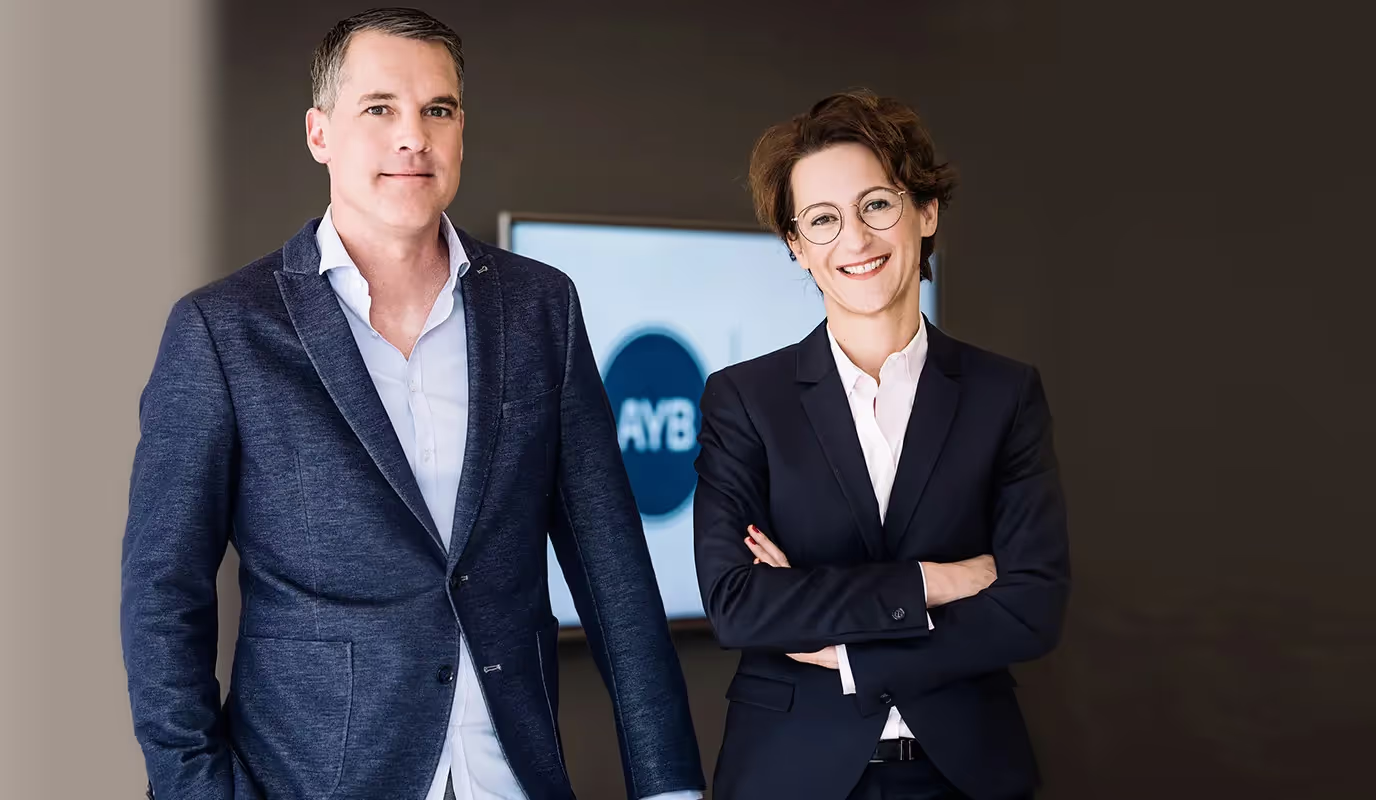
A large part of Germany's economic output is generated by family businesses. When it comes to digital transformation, SMEs, which are so important, have a lot of catching up to do. SME experts Katrin Schwarz and Oliver Stiefenhofer are doing everything they can to change this and have made the “suitability for grandchildren” of family businesses their mission.
In an interview with the two managing directors of Düsseldorfer AYB | About Your Business GmbH It is about future competencies, the importance of digital sovereignty and the central challenges and success factors of transformation projects of German family businesses.
How suitable for grandchildren are German family businesses and what role does digital sovereignty play?
In the past, sovereign action was a hallmark of SMEs. In the context of digitization, we are observing a certain lack of orientation. It is unclear what, how, with whom and why to successfully pass the company on to the next generation. Many companies are externally determined by customers and are driven by competitors. The sovereignty, proactive progress and the courage to leave the comfort zone in order to gain experience for growth — that has been lost to a certain extent.
Being digitally sovereign also means being aware of your strengths and weaknesses and being open to cooperation. If you do everything yourself, you won't be successful in this case — unfortunately, the topic is far too complex for that.
Digital sovereignty is not only a question of technology, but also of people and organizations with their respective interactions. Only if these factors are balanced will the company be successful and suitable for grandchildren.

They focus on advising family businesses. How would you describe their special features?
The corona crisis has proven how innovative companies can be. We would like to see this innovation back for Germany. Digital sovereignty requires a certain willingness of the organizational form. With their strengths in terms of innovation, leadership and willingness to make decisions, family businesses offer ideal conditions. They have a strong culture of values. This is about quality, flexibility and the responsibility of the family, but also towards employees and their families, to pass on the company well or even better. This value-driven continuity is different from the profit-driven quarterly thinking of listed companies. Family businesses think over longer periods of time, across generations, and are faster and more resource-oriented. There is a different way of working together, a unique DNA, a strong trust in employees and from employees in the company. The culture of values, this strength to bring employees along, that is unbelievable value.
Why is digital sovereignty so important for family businesses?
Family businesses grow in generations: The founder usually had a brilliant idea that is developed or managed over the next generations. Some companies tend to rely on past successes or do not have a clear family strategy or succession plan. In addition, the view of one's own business model is different than in organizations that are managed with external competencies. They must first recognize the need for digitization. Innovation is driven by different perspectives. For this reason, family businesses increasingly need an external view of their company. In addition, the issue of digitization is so complex that a patriarch cannot solve it alone as before. This requires collective intelligence within the company and external partners. And the more diverse the employee and management structure, the more innovative and successful it will be.
Which digitization topics concern SMEs the most?
You can't tie it down to technical topics. As a rule, companies are stuck in process optimization. The things that would really be necessary are not being done. In some areas, innovations are promoted, but these remain isolated solutions and the questions of dependencies or which part of the strategy they contribute to remain unclear.
Some are focused on innovating products and services, but there is still a lot of catching up to do when it comes to business models. The right connection to new business models, to innovations, to focus on the customer, to look at other markets, to bring platform ideas into play — many are still a long way off.
How do you approach a transformation project?
With a very methodical analysis, we examine the dimensions: Strategy, Processes & Efficiency, Innovations & New Business Models, People & Cultures, Partners & Public Image and determine the level of digital maturity. We then analyse the challenges and fields of action in a pragmatic in-depth analysis and, together, create a clear picture of the future. We then have a clear plan, a digital roadmap, of what we want to achieve over the next few years. Projects and measures are derived and tracked from the strategy, which is regularly reviewed. Solyp 4.0 supports us with various key figures, KPIs, surveys, feedback, etc., provides holistic monitoring on all topics and makes the transformation controllable. In this case, there is no alternative to transparency: to identify dependencies and critically question what contributes to which part of the strategy. It is a constant pursuit of defined steps that lead to digital sovereignty at the end of the day.
You have to bring a lot of commitment and have experienced people on site to change cultures, mindsets, years of working methods and bring missing skills to the organization. It often takes years. During the course of the projects, we bring in leading experts from our cooperation partners for the respective topic at the right time.

So successful transformation projects are cooperation and collaboration projects?
We see cooperation and communication as part of our business model and as a strength. The topic of digital change is so complex that it can only be tackled in collaboration with experts and the use of innovative software. There are usually several actors involved in a project: employees, managers, consulting firms, service providers, etc. This only works if everyone works on transparent measures, with the same information and perspective on things. If, like us, you orchestrate many customers or customer projects and don't know at the push of a button whether everything is going according to plan or not, then you risk setting goals and the necessary control.
Without Solyp 4.0, it would not be possible to be so scalable, flexible and predictable in our business model. In doing so, we do not use existing software modules, but develop them according to customer requirements. That is what makes Solyp and the collaboration with Evolutionizer so unique for us: They understand what we need, develop and deliver for our customers.
Orchestration is not the only added value for the customer. In customer projects, we often combine silos and replace legacy issues. Everyone has a BI tool, a project management tool, a poor collaboration solution, and we concentrate everything on the platform in the best possible way. Customers are therefore significantly faster, more agile and, thanks to the data and facts, clearer in their decision-making.

What are the biggest challenges faced by family businesses when it comes to digital transformations?
The combination of process, product & service, but also radical business model innovation, requires courage. One challenge is risk aversion with regard to economic indicators — i.e. investments. You can approach this in a structured way by taking small iterative steps.
Our experience shows that the bolder the company is, the greater the successes.
Technology isn't the challenge. The challenge is the person, the organization and the innovation-friendly corporate culture — open, respectful, trusting. This interaction only works with good communication and good leadership. Innovation leadership means innovation in leadership: In yesterday's environment, I can't think of tomorrow. The mindset must be changed.
And there is a methodology for how I promote innovation: Today, people innovate differently, in smaller steps, in close coordination with customers. That is something that SMEs lack. Collaboration is more likely to be thought of in terms of departments and silos.
What are the plus points?
Family-run companies are faster when they have made the decision compared to non-family-run companies. Once the path has been taken, it is very fast, very efficient and resource-oriented. On the one hand, this is due to the hierarchical level and the bonus of trust in employees — but also vice versa. If employees are not intrinsically motivated, it is extremely difficult to change. If we succeed in leading companies with their strong values so that they can innovate alone because they have developed the organization and use the technology to be innovation leaders — then we have achieved our goal.
Thank you very much for the interview.

About AYB | About Your Business GmbH:
The name says it all: AYB's Change Architects are all about family businesses and how they secure the future of future generations with digital sovereignty. Learn more
Katrin Schwarz has 20 years of experience in management positions in medium-sized companies and excellent analytical expertise. Their experience in SMEs and the effectiveness of the “new” world convince them to combine the best. She is a communication lover, networker and constantly strives to improve things.
Oliver Stiefenhofer has specialized in advising medium-sized companies for over 20 years. He knows the pain points of family businesses, their challenges and the requirements of their stakeholders. He has discovered the passion for relieving his clients' fears of turning to new technologies and seeing and helping to shape changes in the course of digitization holistically.