Innovation Portfolio Management for High-Impact Outcomes
Fewer projects, more impact

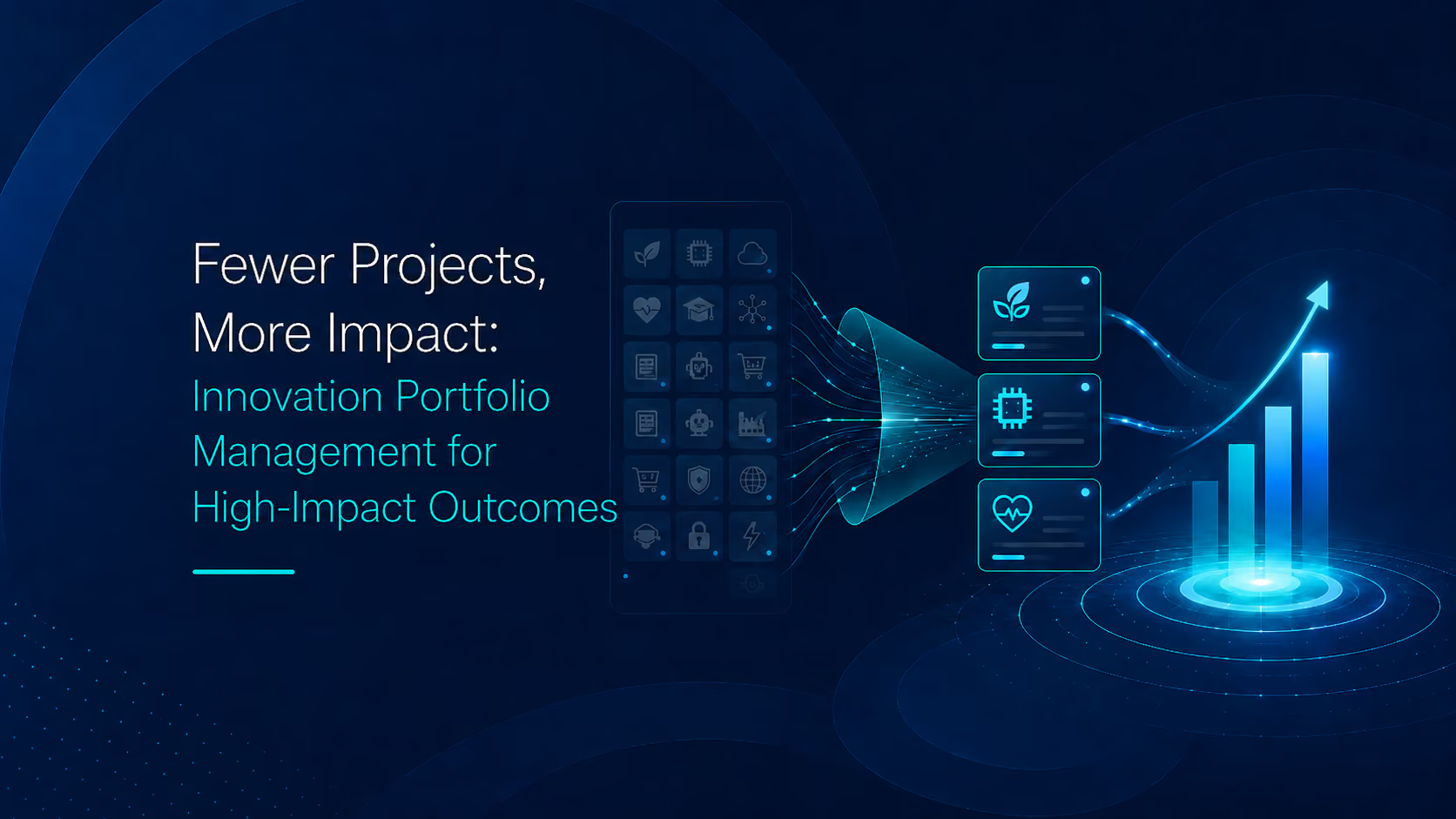
An innovation portfolio is a set of bets. Some pay off, many do not, and no one can know in advance which ones will ultimately win. Professional investors handle this uncertainty with discipline: they define priorities, keep the portfolio balanced, and exit positions that do not perform – without sentimentality. In innovation management, many companies still lack that discipline. Yet effective innovation portfolio management is now what determines whether R&D budgets create growth or disappear across too many initiatives.
The problem is rarely too little innovation
If you examine the project landscape of a typical industrial manufacturer or automotive supplier, you rarely find an innovation deficit. What you find is fragmentation. Dozens of historically grown initiatives run in parallel, many of them small, incremental, and hard to justify strategically. They consume exactly the engineering capacity that the bigger bets need. The symptoms are similar everywhere: there is no defensible ranking of investment opportunities, projects with limited value contribution survive one budget cycle after another, and at some point the technology roadmap becomes disconnected from the corporate strategy.
Four levers separate a crowded portfolio from an effective one.
1. Prioritize like an investor
It starts with a complete ranking of all investment opportunities, assessed against qualitative and quantitative criteria: market potential, strategic fit, technical feasibility, and resource requirements. Bosch illustrates what this can look like at scale. For years, the company has visibly shifted its development resources toward electrification and software because the strategic priority was clearly defined. Traditional projects had to subordinate themselves to that ranking, no matter how valuable they may have been individually. That is the essence of prioritization: not everything good gets done. The most important things get done first.
2. Have the courage to cut
The most powerful and, at the same time, least popular lever in innovation portfolio management is stopping projects. In the early 2000s, Lego was on the brink of bankruptcy, partly because its product and innovation portfolio had expanded in every direction, from theme parks to software. Only a radical refocus on the core business made possible the comeback that is now cited in management seminars everywhere. Apple provided the blueprint in 1997: Steve Jobs reduced a product lineup that had grown into dozens of variants to a handful of products, creating the focus that later produced the iPod and iPhone. For your own R&D portfolio, the practical implication is clear: every low-value project you stop funds the bets that matter.
3. Anchor technology bets in strategy
In addition to near-term product projects, a balanced portfolio needs dedicated technology bets with a longer time horizon.The prerequisite is that the technology priorities for the next three to five years are explicitly defined and that every technology project is regularly measured against them. ASML has shown the value of strategically protected long-term bets. EUV lithography was developed for more than a decade despite significant skepticism and is now the foundation of a de facto global monopoly in chip manufacturing. Without firm strategic anchoring, a project like that would hardly have survived three budget cycles.
4. Operationalize Portfolio Management
The fourth lever may seem less visible, but it determines whether all the others work: a defined process with a fixed cadence, clear decision rights, and reliable data. The pharmaceutical industry has demonstrated for decades how disciplined portfolio management works under high uncertainty. Stage-gate decisions with clear stop criteria are standard practice there, because every project carried forward for too long can cost hundreds of millions. Manufacturing companies can directly adopt this principle: regular portfolio reviews with real go/stop decisions instead of simply rolling forward last year’s budget.
Why it fails in Excel
In practice, these four levers rarely fail because of a lack of will. They fail because the working foundation is missing. When project data sits in dozens of Excel files and PowerPoint versions, every portfolio decision becomes a heavy lift: numbers are outdated, assessments are not comparable, and no one is fully sure which version is current. The prerequisite for ongoing, rather than annual, portfolio decisions is a shared, always-current data foundation across all projects, resources, and strategic objectives: a single point of truth. Only then does the portfolio review becomea steering instrument instead of a look-back exercise.
Fewer projects, more impact
Innovation portfolio management is one of acompany’s core strategic disciplines, even if it is often treated like administration in day-to-day work. Companies that prioritize like investors, cut consistently, anchor technology bets in strategy, and turn all of this into a clear process with a shared data foundation get significantly more out of the same budget. Fewer projects, more impact is not a cost-cutting logic. It is the condition that gives the important bets a real chance to succeed.