What a good innovation strategy can learn from the automotive industry
Less is more.

A recent study by Bain & Company surfaces a number that's worth sitting with: the most innovative automakers spend less than a third of what traditional manufacturers invest to develop a new vehicle. Chinese insurgent OEMs average just 27 percent of the development costs of the top five German automakers – while matching or exceeding their output. Established brands often need 48 to 54 months to bring a new model to market; the fastest competitors do it in 24 to 30. Not as a one-off fluke, but reliably, model after model.
It would be easy to write this off as a footnote from one industry. It shouldn't be. What Bain is really describing isn't an automotive phenomenon – it's the consequence of a missing or watered-down innovation strategy, a pattern that shows up in nearly every organization with meaningful product development, once it's grown large enough, old enough, and successful enough to accumulate complexity without noticing.
Complexity is the hiden cost driver
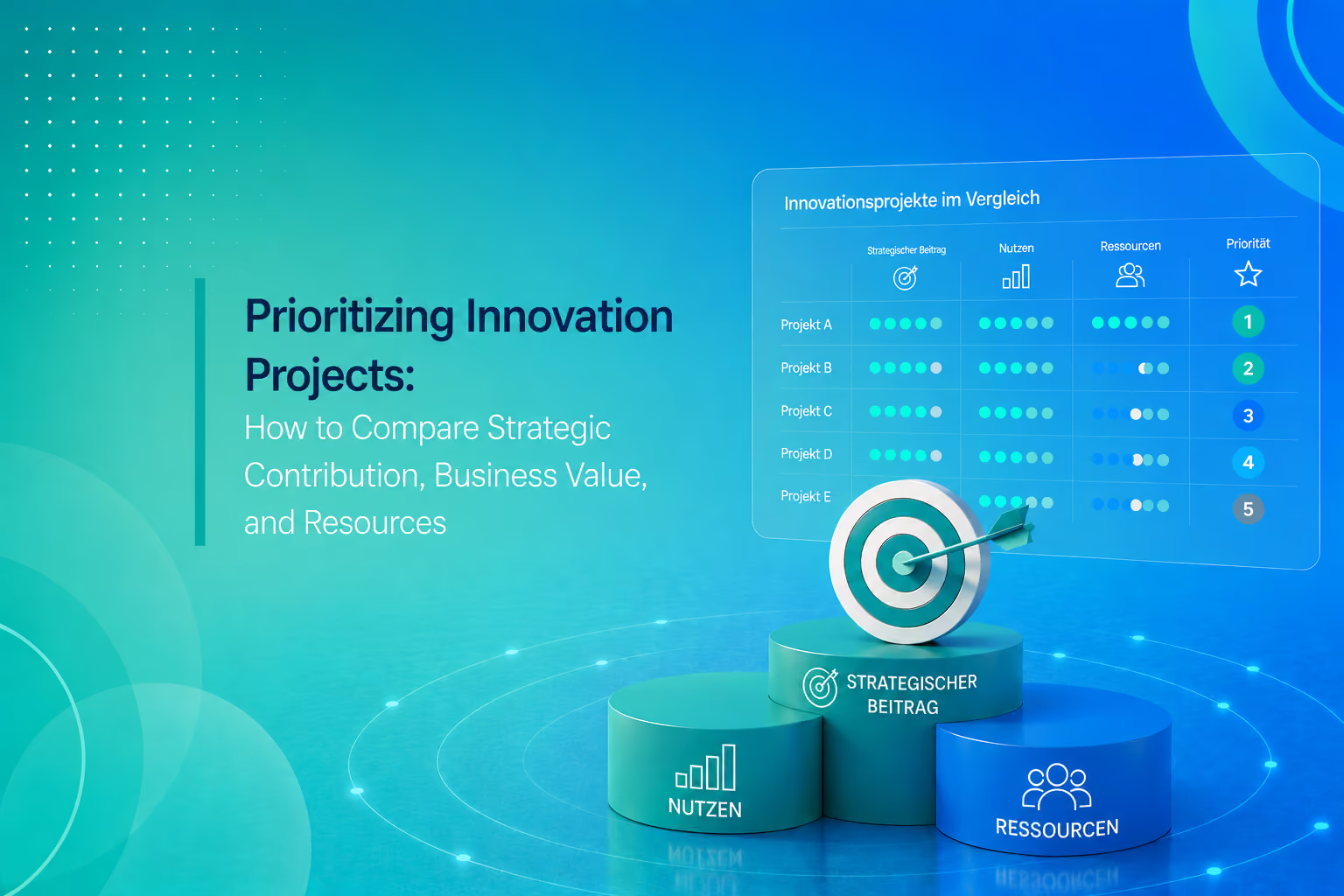
The first instinct under cost pressure is almost always to cut the budget: fewer people, fewer projects, less of everything. The problem, as the Bain analysis makes clear, is that this instinct rarely addresses the actual root cause. The more effective lever sits elsewhere – in the innovation strategy itself, and specifically in the product portfolio that flows from it.
Some European manufacturers have expanded their model lineups by roughly 250 percent since the turn of the millennium. One major Asian competitor today runs nearly the same number of models it did in 2000 – with comparable, in some cases better, market coverage. That's the real scandal buried in the numbers: more variants haven't translated into more market share over two decades. What they've translated into is more internal overhead – more parallel development tracks, more coordination loops, more points in the process where delays quietly stack up until no one can say with certainty why a given project is taking so long.
Anyone who's worked on a product roadmap at an established company recognizes this dynamic firsthand, well outside the auto industry. There's rarely a single moment where someone consciously decides to pursue five parallel variants instead of two. It happens gradually – a special reques there, a market requirement there, a project that survives past its expiration date for political reasons rather than strategic ones. Eventually the portfoliois carrying weight that nobody is actively managing – and that's the symptom of an innovation strategy that was written down once but never consistently enforced.
Anyone serious about freeing up innovation resources has to start by asking a harder question than "how do we develop faster?" The real question is: what are we even building anymore – and does it genuinely serve the strategy, or is it just still running because it's always been running? That question can't be answered without real visibility into the full project portfolio. And in practice, that's usually where things break down – not for lack of will, but for lack of visibility.
Speed and cost are two slides of the same coin
One of the study's more sobering findings concerns the relationship between development time and development cost: they're strongly correlated. Companies that develop faster typically also develop more cheaply. That cuts against the common – and fairly persistent – assumption that speed automatically costs more money or comes at the expense of quality.
The fastest companies aren't getting there by pushing existing processes harder. They're getting there by running different processes. Key steps happen in parallel instead of sequentially. Suppliers and partners are brought in early, rather than after the major decisions have already been locked in. And decisions get frozen on schedule, instead of staying open until just before launch "to be safe." Companies that leave the door open to late-stage changes end up paying for it twice – in both time and money, almost always at the same time.
There's a second factor here that often gets lost in conversations about development speed: the leading companies improve their products continuously over a model's lifecycle, instead of bundling every update into rare, large releases. Software updates, incremental improvements, small iterations rather than one big swing every few years. That spreads risk and effort more evenly over time – and it's a principle that applies far beyond vehicles, to nearly any form of product and innovation development. Anyone who's seen this play out in software recognizes the pattern instantly the moment it shows up in a completely different context.
AI is changing where effort is even needed
The third lever the study describes is probably the one getting the most airtime right now – and, just as often, the most misunderstood: artificial intelligence as a structural accelerant in the development process, not a nice-to-have tool bolted on somewhere along the way.
The distinction is worth examining closely. In many cases, AI automates individual tasks: generating documentation, running automated quality checks on engineering drawings, or searching existing parts data for lower-cost standard components that would work just as well. These are useful but limited effects. It gets more interesting where AI doesn't just speed up individual steps but eliminates entire blocks of work – for example, when digital twins and simulation absorb a significant share of the physical prototype testing that used to take months.
The critical point here, and one that tends to get skipped in the broader conversation, is that these effects only materialize if the foundation is solid. Nobody benefits from automated documentation if the underlying data on projects, resources, and decisions is scattered across five different spreadsheets, three different tools, and one project lead's memory. AI amplifies existing strength. It amplifies existing disorder just as reliably. Companies that don't structure their innovation processes first end up building speed on a foundation that can't hold it – and they usually find that out only once it's too expensive to fix.
The common threat: a clear innovation strategy before speed
What actually connects all three levers – portfolio focus, process discipline, and the deliberate use of AI – is a precondition that sounds simple and is, in practice, rarely met: an innovation strategy that doesn't just exist on paper but actually governs which projects get pursued, with what resources, and toward what strategic goal.
This isn't unique to automakers. Any company running an active innovation or R&D pipeline recognizes these three symptoms, often all at once: projects keep running because they started years ago, not because they still deserve top priority today. Key decisions get made too late because nobody has real visibility into the dependencies between teams and projects. And new tools – including AI tools – get rolled out without anyone rethinking the process underneath them, so a fast tool ends up bolted onto a slow, unclear process and ends up looking slow itself.
That's exactly where the difference shows up between an innovation strategy that was merely written and one that actually functions day to day: building transparency across the full project portfolio, concentrating resources where they carry the most strategic weight, and designing decision pathways that enable speed instead of slowing it down by default. Platforms like EVO-Cloud are built for exactly this purpose – not as an add-on tool sitting next to the actual innovation process, but as the structural foundation that makes an innovation strategy tangible in the first place, and on which speed, focus, and eventually new technologies like AI can deliver their full impact. Without that foundation, every acceleration effort stays piecemeal.
The auto industry just happens to be the clearest, best-documented example, because the numbers are so visibly public there. But the underlying lesson transfers directly, whether the context is vehicles, software, industrial equipment, or services: a strong innovation strategy starts by deciding what not to pursue – and that's exactly what creates the room for what actually matters.