Stage-Gate, agile, or hybrid: Choosing the right R&D model
In many R&D departments, Stage-Gate and agile teams operate side by side. The question is not which model is better – but which one is right for each project.

In many R&D departments, two worlds operate side by side. The hardware team follows a strict Stage-Gate process. The software team plans in sprints. At the portfolio meeting, someone tries to bring both together on a single slide. The outcome may sound familiar: gate decisions based on outdated data, sprint progress that management struggles to put into context, and resource conflicts that surface too late.
That is why asking “Stage-Gate or agile?” is too narrow. The more important question is: Which governance model is right for each project, and how can you maintain visibility across the entire portfolio? This article explores where each model excels, when a hybrid approach makes sense, and which criteria should guide your choice.
Stage-Gate: Clarity and control when investment risk is high
The Stage-Gate process, developed by Robert G. Cooper, divides a development project into phases, or stages, separated by decision points known as gates. At each gate, a review board applies defined criteria to decide whether to proceed, revise, put the project on hold, or stop it.
Early gates typically assess strategic fit, alignment with the product architecture, and an initial high-level effort estimate. Later gates evaluate revenue and profit potential, risk, timing, and resource commitments.
Key strengths:
- Management visibility: Each gate produces a documented decision with clear accountability
- Risk control: Funding is approved in stages rather than committed all at once
- Comparability: Consistent criteria make it possible to compare projects across the portfolio
- Regulatory compliance: In industries such as pharmaceuticals, chemicals, and automotive, documented approvals are often required
Limitations:
Stage-Gate assumes that requirements are largely known at the outset. When uncertainty is high, as with new business models or software-intensive products, the process can quickly become cumbersome. Teams end up preparing documentation for the next gate instead of focusing on the customer. Insights gained between gates often reach decision-makers too late.
Agile: Speed and learning under high uncertainty
Agile methods such as Scrum and Kanban emphasize short iterations, early customer feedback, and a continuously evolving backlog. Rather than planning everything up front, the team learns with each sprint.
Key strengths:
- Rapid validation: Assumptions are tested early through prototyping and user testing
- Flexibility: New insights feed directly into planning
- Focus on value: The team delivers usable results at short intervals
The limitations:
In traditional industrial R&D, agility approaches run up against physical constraints. You cannot iterate on injection molding tooling in just two weeks. Certification processes and supplier lead times require firm schedules. From a portfolio perspective, there is often no clear answer to the question management cares about most: Is this project worth further investment?
Hybrid: Gates for decisions, sprints for execution
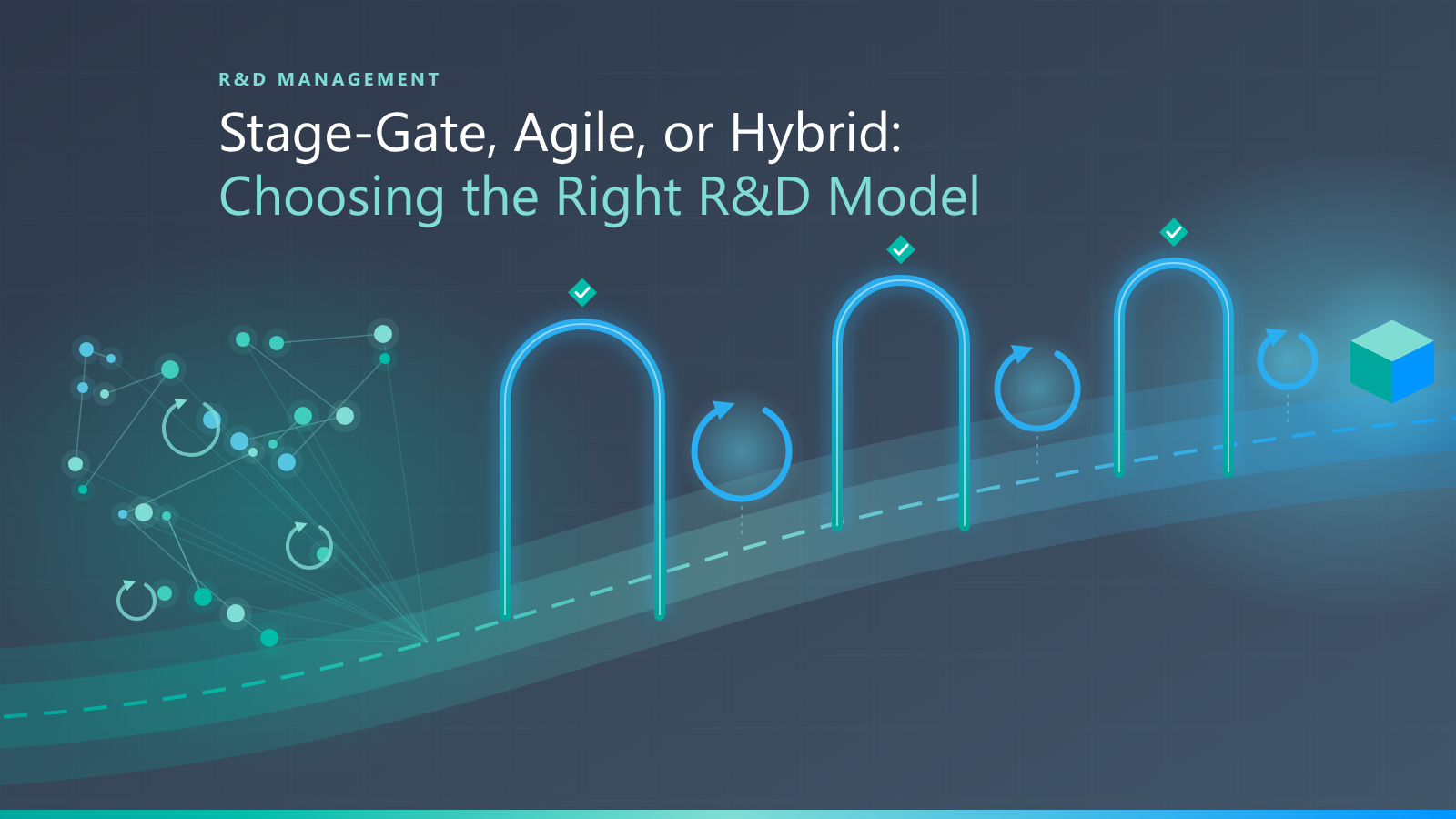
A hybrid approach, often called Agile-Stage-Gate, combines the two models. Gates remain management decision points, while teams work in sprints within each stage.
This fundamentally changes how gates work. Instead of reviewing extensive documentation, the review board evaluates validated results: What did customer testing reveal? Which technical risks have been resolved? How has the business case changed?
One proven pattern is an agile frontend and a lean back end. In the early stages, teams explore trends, innovation opportunity areas, and ideas. Ideas pass through lightweight check-in gates. Product development with defined stages, gates, and workflows begins only after a concept has been validated and prioritized. Maturity stages such as “idea,” “validated,” “prioritized,” and “implementation underway” give everyone a clear view of each initiative’s status.
In practice, a hybrid project often looks like this:
- Early phases (concept, feasibility): A strong agile focus, with rapid prototyping and customer feedback
- Gates: Focused Go/Kill decisions based on what the team has learned, rather than on presentations
- Later stages (manufacturing scale-up and regulatory approval): More plan-driven, because tooling, suppliers, and certifications require fixed milestones
This preserves the speed of agile teams while maintaining control over investments and risks.
Which model fits which project? Five decision criteria
Choosing a governance model should be a deliberate decision for each project rather than a matter of ideology. The key considerations are the degree of innovation, complexity, and project requirements. These five criteria can help you assess the right fit:
For example: Further developing an existing line of machinery is a classic application of Stage-Gate. A digital service built around that machine, such as predictive maintenance, benefits from an agile approach. A new product platform combining hardware and software is a typical candidate for a hybrid approach. Keep in mind that the model can change as a project progresses. An initiative that starts with an agile approach often shifts to a more plan-driven mode after successful validation
The real challenge: one portfolio, multiple models
Once you deliberately apply different governance models to different projects, a new challenge emerges. How do you compare a Stage-Gate project in Stage 3 with an agile team in its fifth sprint? How do you see where resources are committed and which projects contribute most to your innovation strategy?
Four principles help you maintain portfolio visibility across different models:
- A shared evaluation framework: Regardless of the model, assess all projects against the same criteria: strategic contribution, market attractiveness, competitive strength, risk, and resource requirements.
- Consistent decision points: Agile projects also need regular portfolio reviews. The cadence may vary, but the question of whether to continue or stop remains the same.
- Match resource demand tocapacity: Only by comparing resource demand with available R&D capacity can you determine whether your portfolio is realistic. Linked market, product, and technology roadmaps make dependencies visible.
- A shared data foundation: Gate outcomes, sprint progress, and resource planning belong in one system, rather than scattered across Excel spreadsheets, Jira boards, and presentations
Data informs decisions, but it does not make them. Your decision-makers retain final authority over whether a project continues or stops.
Conclusion: The model follows the project, not the other way around.
Stage-Gate, agile, and hybrid are tools for different situations, not competing camps. Stage-Gate provides control when investments are high and requirements are clear.
Agile methods accelerate learning when much is still uncertain.
A hybrid approach brings the two together and is particularly well suited to mechatronic products and platforms. The key is to choose the model deliberately for each project while maintaining a consistent evaluation framework, clear decision points, and a shared data foundation across the portfolio.