Prioritizing innovation projects
Why a single priority score is never enough – and how to reach decisions that actually steer your portfolio.

In the portfolio review, three initiatives are up for a decision. The first promises a strong strategic contribution but depends on specialists who are already fully allocated. The second could start immediately, but its economic potential is limited. The third appears to offer substantial value but still lacks reliable customer evidence.
Which project should take priority?
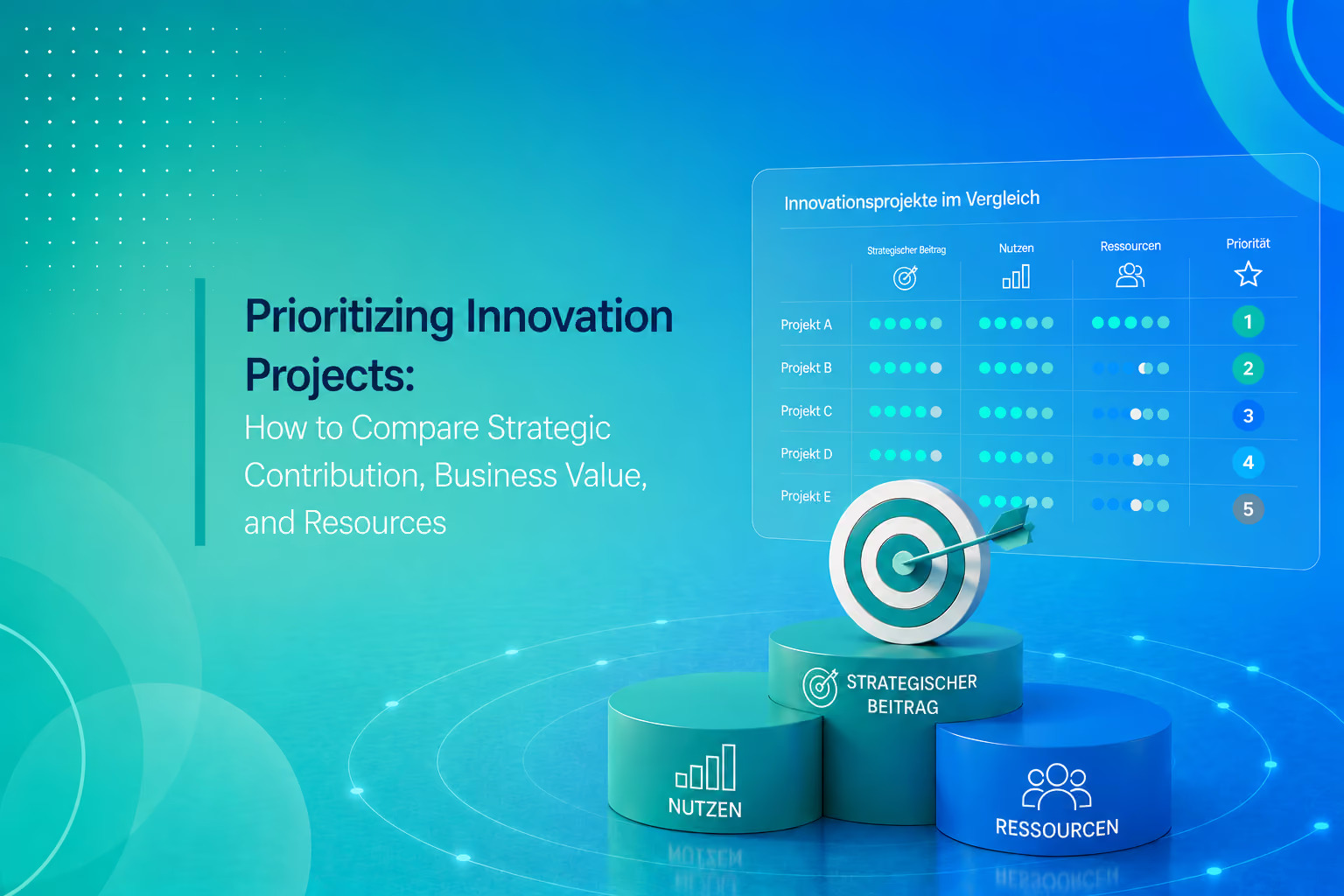
Innovation projects can be prioritized transparently when expected value, the strength of the underlying evidence, and resource requirements are assessed separately. First, each initiative is evaluated against a consistent set of criteria. The next step is to determine which combination of initiatives can actually be delivered with available capacity.
Why a single priority score is not enough
A near-market product project may already have revenue forecasts. An early-stage technology initiative, by contrast, may primarily offer strategic potential and future options. If both are evaluated solely on expected financial return, the more mature initiative will almost inevitably come out ahead.
As discussed in our article "Measuring Innovation: Why ROI alone can hold Innovation back", evaluation criteria must evolve as an innovation initiative matures.
Resource demand is not a value criterion either. A project does not become less valuable simply because it requires six developers. It may, however, be impossible to execute under current conditions. Multi-criteria decision-making methods are well suited to these situations, but they must be tied to the portfolio's actual resource constraints.
Establishing comparability first
Before scoring begins, three questions should be answered:
- Is the project mandatory or discretionary?
- Is it an incremental improvement or a fundamentally new solution?
- Is it in the ideation, validation, or execution phase?
A regulatory initiative does not compete on the same terms as a discretionary product innovation. Likewise, an early-stage idea cannot be expected to provide the same evidence as an initiative approaching launch. ISO 56007 also notes that no single method is equally suitable forevery innovation context.
Evaluate expected value consistently
For discretionary innovation initiatives, a model with four value dimensions may be sufficient:
These weights are illustrative only. A company facing intense margin pressure may place greater weight on economic contribution. If a fundamental technology shift is underway, strategic contribution and option value may deserve more emphasis.
The key is to derive the weighting from corporate strategy and lock it in before individual projects are scored. Otherwise, criteria can quickly be adjusted to favor the initiative that was preferred from the outset.
Each criterion is then scored from zero to five, using explicit scoring anchors. A score of five for strategic contribution, for example, should indicate a demonstrable contribution to a prioritized business objective rather than simply the view that the initiative is "very important."
Each score should also include an evidence rating. High market potential based on an assumption should be treated differently from the same score supported by validated customer data.
Assess resources and constraints separately
Once value has been assessed, the next step is a feasibility review. The most relevant factors are person-months, critical skills and resource bottlenecks, investment requirements, and time to the next verifiable outcome.
In the portfolio review, this could lead to the following decision: Start the process innovation that can be delivered quickly. Give the technology option a limited budget for an eight-week market validation. Keep the strategically important customer solution in the portfolio, but do not approve it until the required specialists are available.
The ranking is not being ignored. It is being translated into an executable portfolio.
An Evolutionizer project at Sto illustrates how this approach works in practice. The required decision inputs from participating business units were consolidated in a structured workflow. At the same time, the company established a shared foundation for resource allocation across the R&D portfolio, aligned with strategic priorities.
The EVO-Cloud Solution for Innovation Strategy & R&D Management supports this approach by bringing evaluations, strategic objectives, and resource data into a single view. Decisions remain with people, while the underlying rationale becomes transparent and traceable.
Frequently asked questions about project prioritization
Should resource requirements be included in the priority score?
Not directly. The score should express expected value. Resource requirements and available capacity should then be assessed as part of the feasibility review. This keeps it clear whether a valuable initiative is only temporarily infeasible.
How often should innovation projects be re-prioritized?
In addition to a regular cadence, such as quarterly, projects should be reassessed when assumptions are disproven, costs increase significantly, or critical resources become unavailable. Repeatedly deferred decisions can create innovation debt.
Who should define criteria and weights?
The accountable leadership team should own the weighting. Project evaluations should be cross-functional so that strategy, market, economics, technology, and resources are not considered in isolation.
Conclusion
Transparent prioritization does not mean reducing every decision to a number. It means separating expected value, the quality of the supporting evidence, and actual feasibility. Only then does a project list become a manageable innovation portfolio.