Why innovation fails to deliver results
Only around 20 percent of companies achieve their innovation objectives. One key reason is the lack of consinstent alignment between innovation strategy, corporate goals and execution.


Innovation is widely seen as a critical driver of growth and competitiveness. Expectations and investments are therefore high. Yet, in many organizations, a contradictory reality emerges: despite ambitious innovation programs, measurable outcomes often fall short of expectations.
This is rarely due to a lack of ideas or commitment. More often, companies lack a clear innovation strategy that systematically connects innovation efforts with the overarching business strategy. Initiatives are launched, pilot projects are set up, and budgets are allocated – without clear priorities or end-to-end governance.
As aresult, innovation becomes a blind flight.
When Growing Innovation Budgets Increase Complexity
This challenge is particularly evident in organizations with large innovation and R&D portfolios. As portfolios grow, decision-making becomes increasingly complex:
- Which initiatives truly support the companie’s strategic objectives?
- Where does further investment create value – and where does it not?
- Which innovation projects should be scaled, and which should be deliberately stopped?
Studies show that more than half of companies struggle to align innovation activities consistently with strategic goals. Paradoxically, this challenge intensifies as innovation spending increases. The issue is not insufficient innovation – but uncoordinated innovation.
When transparency around objectives, maturity levels, dependencies, and resource allocation is lacking, R&D leaders lose visibility into their innovation landscape – and with it, their ability to steer effectively.
The Critical Gap Between Strategy and Execution
In practice, innovation rarely fails because of strategy alone or execution alone. The greatest challenge lies in the gap between the two.
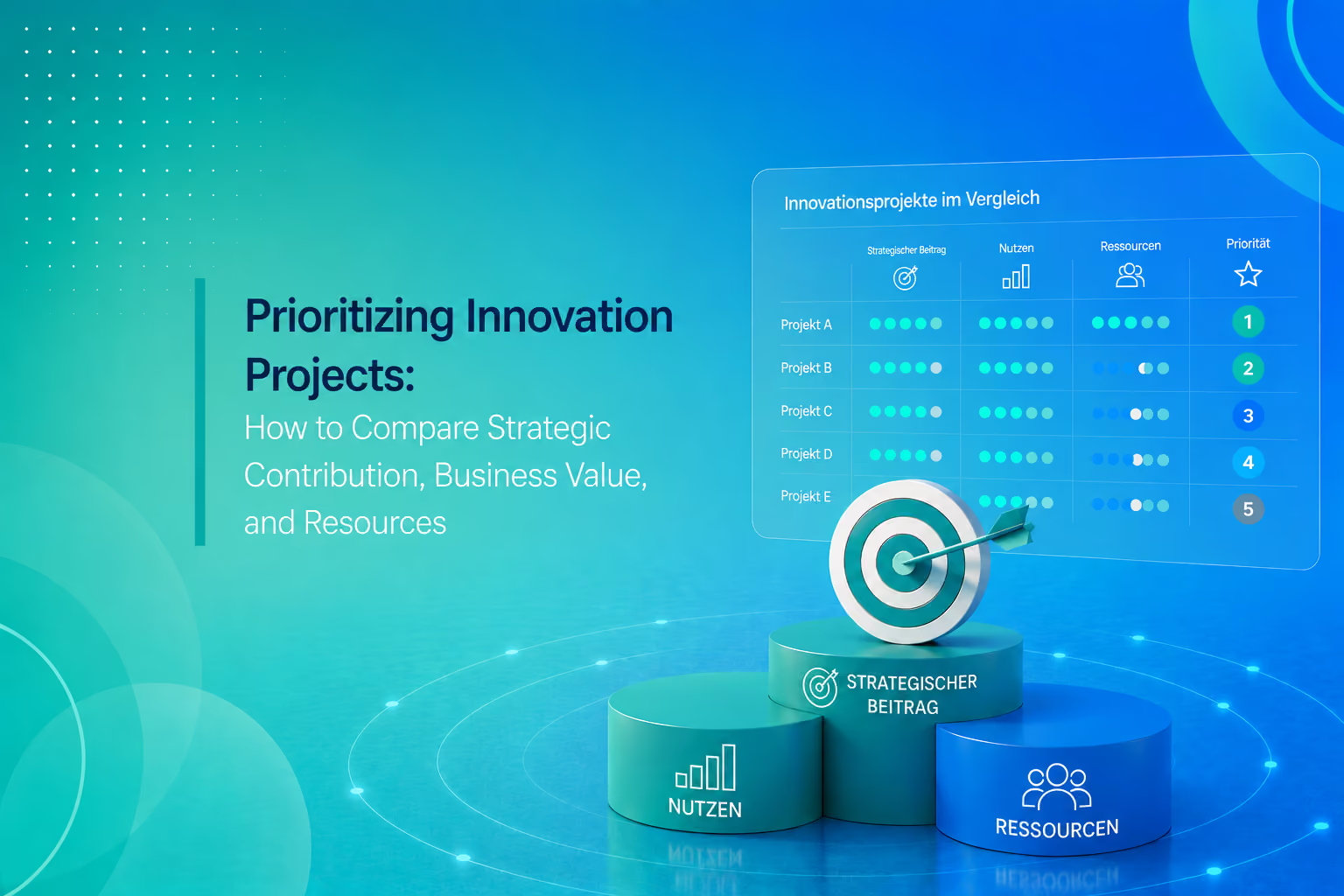
Strategic goals may be clearly definied and initiatives actively pursued, but without a connecting framework, it remains unclear how individual projects contribute to overall success. Only with a coherent innovation portfolio, clear decision logic, and measurable governance metrics can this contribution be made transparent.
This is where the need for end-to-end innovation governance becomes evident – bringing strategy, ideas, portfolios, and execution together within a single, integrated framework. Only when innovation is managed holistically does it become predictable and its value measurable.
Open Innovation Requires Clear Guardrails
Approaches such as design thinking, co-creation, and open innovation ecosystems are gaining importance. They enable companies to involve customers, partners, suppliers, and external experts early in the ideation process. However, the more stakeholders are involved, the more critical clear direction becomes. Without defined innovation domains, priorities, and evaluation criteria, open innovation models risk amplifying existing ambiguity. Ideas may emerge faster, but often fail due to unclear decision-making or insufficient execution capability.
When applied correctly, open innovation accelerates the journey from idea to market readiness and significantly improves strategic fit.
When Innovation Succeeds
Successful innovation is not a matter of chance. It is the result of clear decisions, transparent prioritization, and disciplined execution. Companies that manage innovation strategically achieve stronger growth and greater confidence in their investment decisions.
The ability to digitally orchestrate innovation activities end-to-end – from strategic alignment and innovation and R&D management through execution and performance measurement – has become a decisive competitive advantage.
Learn how companies systematically implement their innovation strategy with the EVO-Cloud here.
-