Successful organizational transformation - Kotter's 8-Step change model


At this point, there has recently been talk of the need for companies to constantly reinvent themselves in order to survive in the long term in today's market environment characterized by complexity, uncertainty and volatility. This includes the development of new products and services as well as the development of alternative business models and the adjustment of corporate culture. However, a strategic realignment is anything but an easy task and is usually met with resistance within the workforce. Aversion to change and the fear of not being up to the challenges are widespread and all too human. Effective change management is therefore essential in order to be able to commit all employees to a new direction.
Change management is always focused on people and aims to implement changes comprehensively, smoothly and permanently. But how can this actually be achieved in practice?
There are now a number of change management theories, but the majority of them originate in the work of leadership and change management thought leader John P. Kotter, an emeritus Harvard Business School professor. In his seminal book Leading Change In 1996, Kotter developed his famous 8-stage model for successful organizational change, which he has continued to refine since then and which is now used by many management consultancies.
The 8-stage model represents a holistic approach for implementing profound and sustainable change. Kotter points out that all eight stages must be completed completely and in the specified order: “Skipping individual steps only creates the illusion of rapid progress and never leads to a satisfactory result” (1997). The eight steps can be divided into three phases: creating a climate for change (steps 1 to 3), involving and empowering the entire organization (steps 4 to 6) and implementing change sustainably (steps 7 to 8).
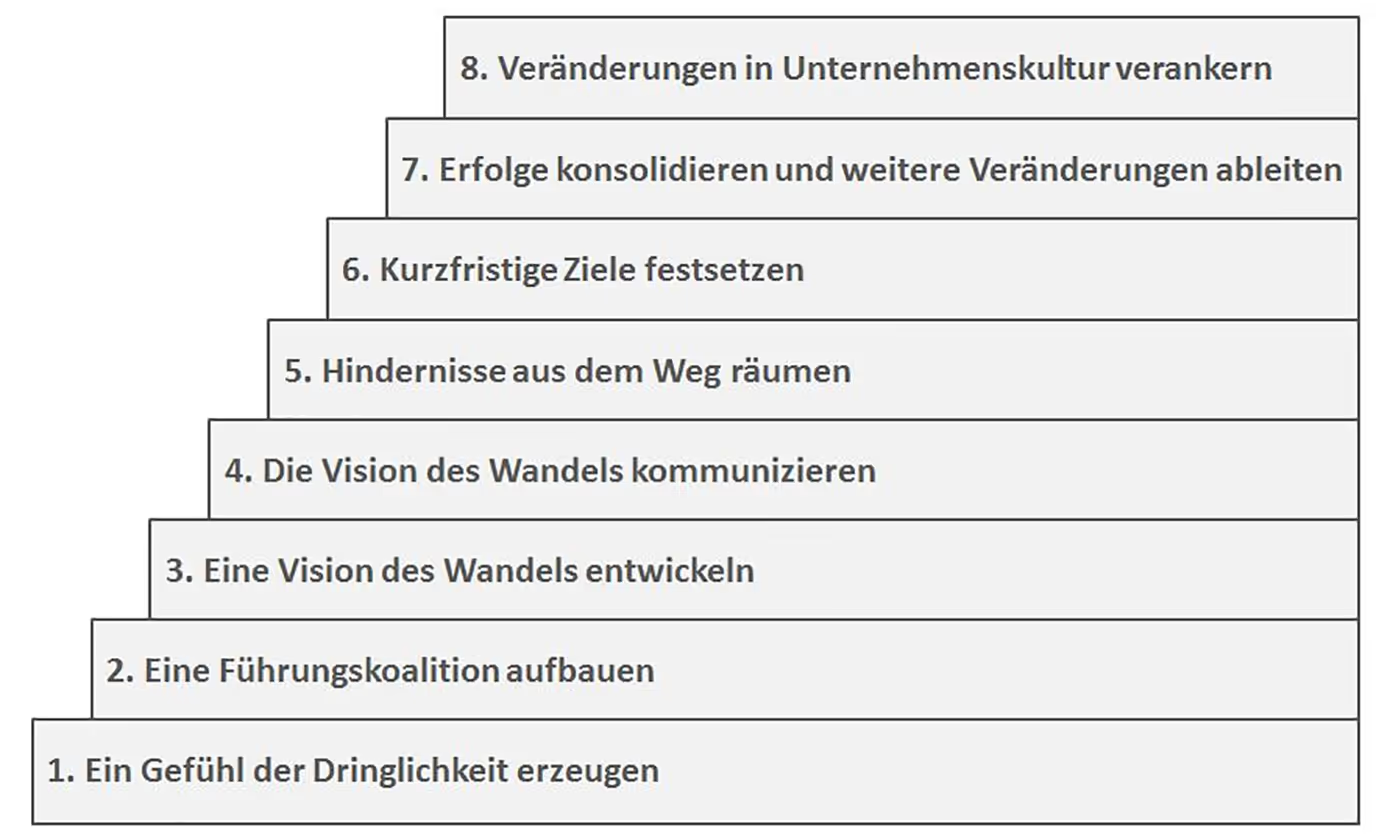
Step 1: Create a sense of urgency
The basic requirement for the successful implementation of transformation projects is that the majority of employees stand behind the desired changes and actively support them. The first step of change management should therefore always be to convince employees of the need and urgency of the changes. That is anything but an easy task. This is even more true for companies that have been very successful in the past. Because complacency is one of the biggest obstacles to change. But Kotter also warns of misunderstood urgency, which stems from fear or anger and is reflected in uncoordinated activism. What is more important is to concentrate on the essentials, continuously, every day anew. Urgency is therefore not only the igniter, but also the engine of transformation processes.
To create a sense of urgency among employees, Kotter recommends showing them the potential opportunities and risks that arise from the corporate environment. This should not only appeal to the intellect of employees, but above all to their emotions. “Seeing, feeling and changing,” is Kotter's motto. To do this, it can be helpful to bring in outsiders, such as management consultants, investors or customers, to help employees look at things from a different perspective.
Step 2: Build a leadership coalition
The next important step for the successful implementation of change initiatives is to put together a strong leadership coalition that represents the entire organization. In order to be able to act effectively, this team should have sufficient powers, credibility, expertise and leadership skills and should pursue common goals within the change process. Mutual trust between team members is also a decisive success factor. This can be strengthened, for example, through regular off-site activities.
Step 3: Develop a vision of change
The task of the management team is now to develop a vision for the future. According to Kotter, a clearly formulated vision fulfills three important functions:
- It serves as a basis for decision-making
- It motivates people to take action in the right direction, even if the first steps towards this goal are difficult, and
- It helps to coordinate the actions of individual departments and employees quickly and efficiently.
The vision has a meaningful effect on employees and is, so to speak, the “glue that holds everything together.” Kotter identifies six key characteristics of effective visions:
- Imaginable: They create a clear picture of what the future will look like.
- Desirable: They address the long-term interests of all parties involved.
- Feasible: They contain realistic and achievable goals.
- Focused: They are formulated clearly enough to help make decisions.
- Flexible: They enable individual commitment and alternative action when circumstances change.
- Communicable: They are easy to communicate and easy to explain.
Step 4: Communicate the vision of change
The next step is to disseminate the vision developed in the previous step throughout the organization, with the aim of gaining acceptance and commitment from employees. According to Kotter, most companies completely underestimate the effort required for this. He advises to continuously propagate the message on all available communication channels and to show a certain willingness to experiment with the choice of methods. Storytelling, for example, is an excellent way to breathe life into a vision and make it understandable to everyone.
However, words must also be followed by action. The leadership coalition should therefore always set a good example and adapt its behavior in line with the new vision and strategy. This reduces potential mistrust and promotes employee motivation and willingness to cooperate.
Step 5: Remove obstacles
However, acceptance and willingness to change within the workforce alone are not enough to successfully drive change forward. Internal structures and systems must also be adapted to the requirements of the new vision and strategy in order to enable employees to act. In addition to personnel systems, information systems in particular play an important role, as Kotter points out. Access to current competition and market information and the smooth exchange of information across departments are a prerequisite for employees to be able to do their work as efficiently as possible.
Step 6: Set short-term goals
Large, long-term change projects often lose steam in the early stages. In order to maintain the motivation and awareness of urgency among all parties involved, short-term goals should therefore be planned and acknowledged accordingly when achieved. Quick successes also have the positive effect of taking the wind out of the sails of critics and cynics. Studies show that companies that achieve significant short-term success are significantly more likely to successfully complete the transformation process.
Step 7: Consolidate successes and derive further changes
However, short-term successes should never tempt you to rest on the laurels you have won or even report the entire project as a success at an early stage. Instead, it is important to use the credibility created by the short-term successes in a targeted manner to embark on further and larger change projects. For this purpose, other groups of people should be involved in the change process. At the same time, the governing coalition should ensure that urgency, transparency and focus are maintained.
Step 8: Anchoring changes in corporate culture
Last but not least, the new standards of conduct and shared values must be deeply anchored in corporate culture. Otherwise, there is a risk that they will be lost again as soon as the pressure to change decreases. To achieve sustainability, Kotter recommends regularly communicating how the new approaches, behaviors, and attitudes have influenced the company's overall performance. In addition, it should be ensured that new employees and aspiring managers believe in the new direction and embody it externally.
Profound transformation processes demand a lot from companies. Kotter's 8-step model provides a solid checklist for most things to consider during such a process. Important prerequisites for each individual step are management by first-class managers, a sense of urgency, open exchange of information and continuous communication at all levels. Specialized software such as the Solyp Strategy Platform can make an important contribution to the latter two by bundling and making all relevant information accessible centrally.
Here Read how John Kotter's 8-step model can lead to success even in the age of digitalization.
sources
Kotter, J.P. (1996). Leading change. Boston: Harvard Business School Press.
Kotter, J.P. (1997). Chaos, Change, Leadership: Leading Change. Düsseldorf: Econ-Verlag.