From Product Strategy to Successful Execution
Interview with our VP Product Management Jonas

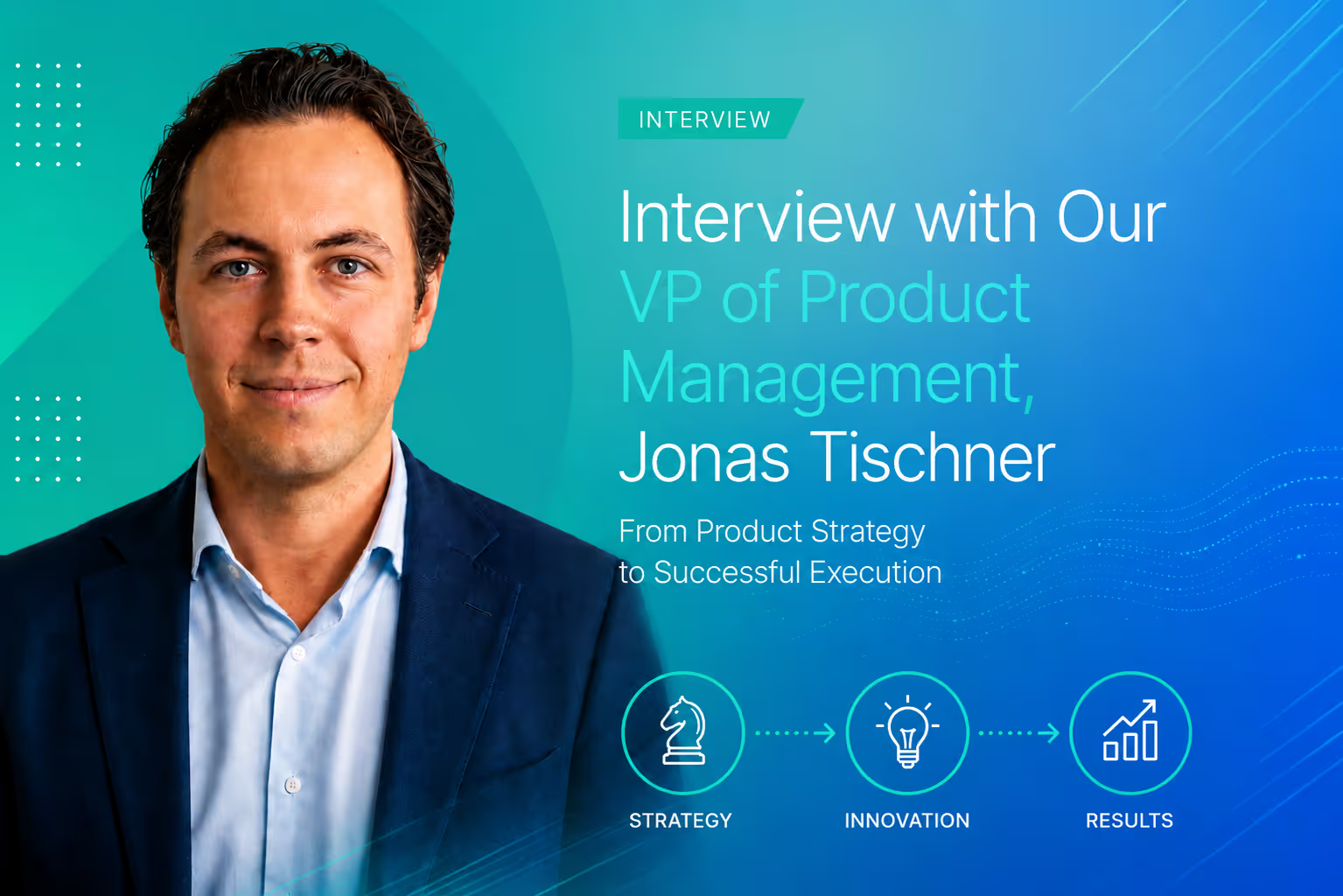
A clear gap between strategy, innovation, and execution still exists in many companies today – in this interview, Jonas Tischner discusses the root causes, common patterns from the field, and key success factors.
Jonas Tischner is Head of Product Hub and Head of Teal Squad at Evolutionizer, and is recognized as an expert in successfully translating strategy into scalable digital products. Thanks to his extensive experience at the intersection of business and technology, he knows exactly where transformations tend to fail inpractice – and how to steer them toward success.
Many companies struggle with a gap between strategy and execution. Where do you see this gap most often in practice?
Jonas: I most often see the biggest strategy-execution gap when it comes to backing concrete goals – Objectives and Key Results, for example – with measurable actions and tracking them systematically. There's frequently a lack of transparency around whether the projects feeding into these goals actually deliver the desired effects.
At one of our clients, for instance, the Operations portfolio clearly illustrates how critical it is to take a close look at initiatives – and especially their forecasts. Without a solid forecast view of impacts and effects, it becomes difficult to course-correct early.
Many companies invest heavily in innovation – yet measurable impact often remains limited. Why is that, in your experience?
Jonas: Many companies invest heavily in innovation, yet see little measurable impact. In my experience, this is usually because innovation goals – or the overall innovation direction – aren't properly linked to and documented through trackable innovation projects.
There's also often a missing end-to-end connection of effects: once innovation projects evolve into development projects and eventually into products, it becomes difficult – without an integrated system – to trace results back to the original goals.
A central point here is maintaining a continuous link between innovation goals, projects, and the resulting effects across the entire innovation process.
When strong strategies or innovations fail, where does it typically break down during execution for your clients?
Jonas: When good strategies or innovations fail, it's almost always execution where the breakdown happens – specifically a lack of connectivity and consistent tracking, especially around reliable forecast figures, clear status updates, and continuous reporting.
Without a connected, end-to-end platform, system breaks quickly emerge – often through reliance on Excel or PowerPoint. As a result, the link between goals, target values, measures, and forecasts gets lost. With the right platform, however, these relationships can be mapped transparently in dashboards based on live data, enabling early course correction.
One example is the use of a control tower, which gives management – the executive board, for instance – early visibility into risks, deviations, and missed milestones, allowing for targeted intervention.
The prerequisite for this, of course, is regular data maintenance and a high standard of dataq uality within the system.
Where the strategy-execution gap becomes visible in practice
Thinking about successful companies – what do they do differently when it comes to connecting strategy, innovation, and execution?
Jonas: What sets successful companies apart is that they tackle the strategy-execution gap head-on by tightly integrating strategy, innovation, and execution. A key success factor here is a single, consistent solution spanning everything from innovation projects to product-to-market projects – in other words, covering the entire journey from the early funnel through development to market readiness. We've implemented exactly this kind of end-to-end approach with many of our clients recently.
The decisive advantage is that no system breaks occur – all data flows together centrally. This makes it possible to directly compare expected and actually realized effects, which in turn makes continuous improvement processes significantly easier and more effective.
To me, that's one of the main drivers behind these companies' success.
What role do structure, governance, or digital platforms play in truly connecting strategy, innovation, and execution?
Jonas: In my view, adigital platform is particularly critical for linking data and processes seamlessly. Equally important is clear governance that ensures a consistentend-to-end process.
This is especially essential in an innovation context – for example, when evaluating ideas or deciding whether an idea should move forward into a development project. That requires clear criteria and a sound evaluation framework.
A central management system like our EVO-Cloud platform can support this kind of governance very effectively – for instance, by defining mandatory fields or evaluations that must be completed before a project can advance to the next workflow step. This ensures that processes remain standardized and decisions stay comparable.
What cultural changes does a company need in order for innovation to truly deliver results?
Jonas: A key success factor is openness to technology – o new trends, technologies, and external market input. In our innovation strategy process, for example, this is supported through integrated trend monitoring, which systematically captures external developments and feeds them into innovation work.
Equally important is the consistent use of clear governance structures throughout the organization. Employees need to follow defined processes and provide all relevant information, forms, and documentation for ideas and innovation projects.
The combination of openness and structured process discipline is what makes an innovation systemtruly effective
Why do so many companies struggle to effectively prioritize their innovation and strategy portfolio?
Jonas: The ability to prioritize effectively often falls short due to a lack of governance – and, by extension, a lack of consistent evaluation and decision-making criteria. Projects can only be meaningfully prioritized when there's a comparable baseline in place.
Another key factor is resource management. Sound prioritization decisions require transparency around the realistic costs and expected benefits of projects, as well as visibility into available resources – both in terms of human resources and budgets or investment funds.
This kind of transparency across the entire project backlog – what projects actually cost and what resources are available – consistently proves to be a decisive success factor in practice. The prerequisite is a clearly defined, unified set of criteria for all evaluations.
What has surprised you most in client projects?
Jonas: What has surprised me most across many client projects is just how heavily Excel- and PowerPoint-based processes still dominate. Meetings are frequently run off manually updated PowerPoint decks, while projects are managed through Excel lists or shared spreadsheets in SharePoint – with all the associated risk of version conflicts and inconsistency.
Resource planning and portfolio prioritization, too, are often handled through highly complex Exce l"solutions" that offer little in the way of transparency or scalability.
Even where management systems are in place, they tend to be isolated, special-purpose solutions built or individual use cases – rarely true end-to-end systems that create real transparency across multiple portfolios.
Altogether, this points to a clear need for unified, integrated management systems that bring data, processes, and portfolios together consistently.